
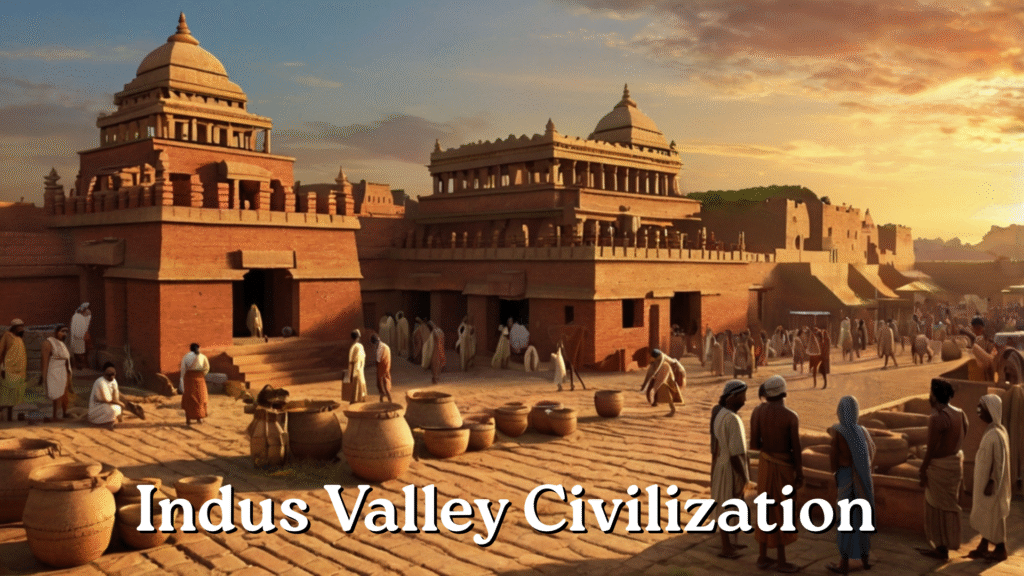
Indus Valley Civilization
The Indus Valley Civilization (IVC), also known as the Harappan Civilization, was one of the world’s earliest urban civilizations. It flourished around 2500 BCE to 1750 BCE in the northwestern regions of the Indian subcontinent, mainly along the Indus River and its tributaries. The civilization spread across parts of modern-day India, Pakistan and Afghanistan, covering over 1.25 million square kilometers.
The IVC was remarkable for its planned cities, advanced drainage systems, granaries and standardized weights and measures. Major sites such as Harappa, Mohenjo-Daro, Dholavira, Lothal, Kalibangan and Banawali reveal the ingenuity and sophistication of the Harappans. They practiced agriculture, trade and crafts and had a structured social life, though their script remains undeciphered.
The Indus people were primarily peaceful, with no evidence of large-scale warfare, and they contributed immensely to the foundation of later Indian culture.
- What is another name for the Indus Valley Civilization?
ANSWER: Harappan Civilization. - Around which year did the Indus Valley Civilization flourish?
ANSWER: Around 2500 BCE to 1750 BCE. - Which river was the main center of the Indus Valley Civilization?
ANSWER: The Indus River. - What modern countries did the civilization cover?
ANSWER: India, Pakistan, and Afghanistan. - Who discovered the first site of the Indus Valley Civilization?
ANSWER: Daya Ram Sahni in 1921 at Harappa. - Who discovered Mohenjo-Daro?
ANSWER: R. D. Banerjee in 1922. - What is the meaning of "Mohenjo-Daro"?
ANSWER: Mound of the Dead. - The Harappan Civilization belongs to which age?
ANSWER: Bronze Age. - Which two cities are considered the main centers of the civilization?
ANSWER: Harappa and Mohenjo-Daro. - Who gave the term “Indus Civilization”?
ANSWER: John Marshall. - What was unique about Harappan cities?
ANSWER: They were well-planned with grid patterns and drainage systems. - What material was mainly used for construction?
ANSWER: Baked bricks. - Which site is famous for its Great Bath?
ANSWER: Mohenjo-Daro. - What was the purpose of the Great Bath?
ANSWER: Likely for ritual bathing. - What were streets in Harappan cities like?
ANSWER: Straight and cut each other at right angles. - What was the system of drainage made of?
ANSWER: Covered brick drains with inspection holes. - What was the largest building found at Mohenjo-Daro?
ANSWER: The Great Granary. - Which site shows a citadel and a lower town division?
ANSWER: Both Harappa and Mohenjo-Daro. - What kind of houses did Harappans live in?
ANSWER: Brick houses with courtyards and bathrooms. - Which site shows evidence of town planning similar to Harappa?
ANSWER: Kalibangan. - What was the main occupation of Harappan people?
ANSWER: Agriculture. - Which crops did they cultivate?
ANSWER: Wheat, barley, peas, and cotton. - What was India’s earliest cultivated crop?
ANSWER: Cotton. - What was the other major occupation besides farming?
ANSWER: Trade and crafts. - With which country did the Harappans trade overseas?
ANSWER: Mesopotamia. - What evidence shows trade with Mesopotamia?
ANSWER: Mesopotamian seals and Harappan goods found there. - What type of transport did Harappans use for trade?
ANSWER: Bullock carts and boats. - What system did they use for measurement?
ANSWER: Standardized weights and measures. - Which site was a major port?
ANSWER: Lothal. - What did they export?
ANSWER: Cotton, beads, metals and ornaments. - What were the Harappans skilled in?
ANSWER: Pottery, bead-making, and metalwork. - Which metals did they use?
ANSWER: Copper, bronze, lead, and tin. - What is the most famous bronze statue from Mohenjo-Daro?
ANSWER: The Dancing Girl. - What does the Dancing Girl represent?
ANSWER: Artistic excellence and grace. - Which statue represents a priest?
ANSWER: The Priest-King. - What material was the Priest-King made of?
ANSWER: Steatite (soapstone). - What designs were common in their pottery?
ANSWER: Geometric and animal motifs. - What kind of jewelry did Harappans wear?
ANSWER: Beads, bangles, and necklaces of gold and semi-precious stones. - What toy evidence is found?
ANSWER: Terracotta carts, dolls, and animals. - Which site is famous for bead-making?
ANSWER: Chanhudaro. - What kind of religion did Harappans follow?
ANSWER: Nature and fertility-based worship. - Which deity did they mainly worship?
ANSWER: Mother Goddess. - Which male deity was worshipped resembling Shiva?
ANSWER: Pashupati (Lord of Animals). - What animals were considered sacred?
ANSWER: Bull and unicorn. - Did they practice idol worship?
ANSWER: Yes, small idols have been found. - Was there any temple structure found?
ANSWER: No clear temple structure found. - What is believed about their burial system?
ANSWER: They practiced burial and cremation. - What symbol was considered auspicious?
ANSWER: The Swastika. - Which trees were worshipped?
ANSWER: Peepal and banyan. - What evidence suggests belief in life after death?
ANSWER: Burials with pottery and ornaments. - What type of script did Harappans use?
ANSWER: Pictographic script. - Has the Harappan script been deciphered?
ANSWER: No. - How many signs are there approximately?
ANSWER: Around 400–600. - What was the direction of writing?
ANSWER: Right to left. - What was written mostly on?
ANSWER: Seals. - Which animal is most common on seals?
ANSWER: Unicorn. - What were seals made of?
ANSWER: Steatite. - What purpose did seals serve?
ANSWER: Trade and identification. - What does the undeciphered script tell us?
ANSWER: They had a developed form of communication. - What might have caused its disappearance?
ANSWER: Loss of literacy after decline. - How was the Harappan society structured?
ANSWER: Possibly class-based but peaceful. - Was there evidence of kings or palaces?
ANSWER: No direct evidence of kings. - What does uniformity in town planning suggest?
ANSWER: Centralized administration. - What kind of clothing did they wear?
ANSWER: Cotton garments. - What did men and women both wear?
ANSWER: Ornaments and jewelry. - Did they have weapons?
ANSWER: Yes, but mainly for self-defense. - Was education developed?
ANSWER: Yes, implied from planning and art. - Were women respected?
ANSWER: Likely yes, as shown by goddess worship. - What did Harappans eat?
ANSWER: Wheat, barley, fruits and meat. - Did they know about weights and measures?
ANSWER: Yes, standardized cubes and scales found. - Around when did the civilization decline?
ANSWER: Around 1750 BCE. - What are possible causes of decline?
ANSWER: Floods, droughts, invasion, or river shift. - Who proposed the Aryan invasion theory?
ANSWER: Mortimer Wheeler. - Which river is believed to have dried up leading to decline?
ANSWER: Saraswati. - What climatic reason is cited for decline?
ANSWER: Change in monsoon patterns. - What natural disaster may have contributed?
ANSWER: Repeated floods. - Did the civilization disappear suddenly?
ANSWER: No, it declined gradually. - Which phase followed the Harappan Civilization?
ANSWER: The Vedic Age. - What did the Harappans contribute to later culture?
ANSWER: Urban planning, hygiene, and craftsmanship. - Which site shows the latest phase of Harappan culture?
ANSWER: Rangpur. - Harappa is located in which present country?
ANSWER: Pakistan. - Mohenjo-Daro is located near which river?
ANSWER: Indus River. - Kalibangan is located in which Indian state?
ANSWER: Rajasthan. - Lothal is located in which state?
ANSWER: Gujarat. - Dholavira is located in which district?
ANSWER: Kutch, Gujarat. - Which site has evidence of a dockyard?
ANSWER: Lothal. - Which site shows evidence of ploughed fields?
ANSWER: Kalibangan. - Which site shows evidence of water reservoirs?
ANSWER: Dholavira. - Which site is known for painted pottery?
ANSWER: Banawali. - Which site is famous for a massive fortification wall?
ANSWER: Dholavira. - Which animal was not known to Harappans?
ANSWER: Horse. - Which animal was most common in seals?
ANSWER: Bull. - Which color was commonly used in pottery?
ANSWER: Red with black designs. - Did Harappans use iron?
ANSWER: No, they used bronze. - What evidence shows use of games?
ANSWER: Dice and chess-like boards. - Did they have writing materials?
ANSWER: Likely palm leaves or cloth (none survived). - What kind of government might they have had?
ANSWER: Centralized civic authority. - What kind of society were they?
ANSWER: Peaceful and urbanized. - What shows their hygiene awareness?
ANSWER: Bathrooms and drainage systems. - What is the modern significance of the Indus Valley Civilization?
ANSWER: It laid the foundation of India’s urban culture.
The Indus Valley Civilization stands as a shining example of human innovation, organization and progress in the ancient world. With its advanced urban planning, trade systems and artistic achievements, it was centuries ahead of its time. The IVC reminds us that even in prehistory, humans sought order, beauty and harmony in their living spaces.
FAQs
- What was the time period of the Indus Valley Civilization?
Answer. It flourished roughly from 2500 BCE to 1750 BCE. - Why is it called the Harappan Civilization?
Answer. Because Harappa was the first site discovered in 1921. - What are the most important sites?
Answer. Harappa, Mohenjo-Daro, Lothal, Dholavira, and Kalibangan. - Was the Harappan script deciphered?
Answer. No, it remains undeciphered till today. - What caused the end of the Indus Valley Civilization?
Answer. Climate change, floods, and river shifts are likely causes. - What was the main occupation of Harappans?
Answer. Agriculture and trade. - What were they best known for?
Answer. Urban planning, drainage systems, and craftwork. - Which site had a dockyard?
Answer. Lothal. - Did they have temples or kings?
Answer. No direct evidence of temples or kings has been found. - What is the lasting contribution of the Indus Valley Civilization?
Answer. Its scientific town planning, hygiene, and art form the roots of India’s early urban culture.


