
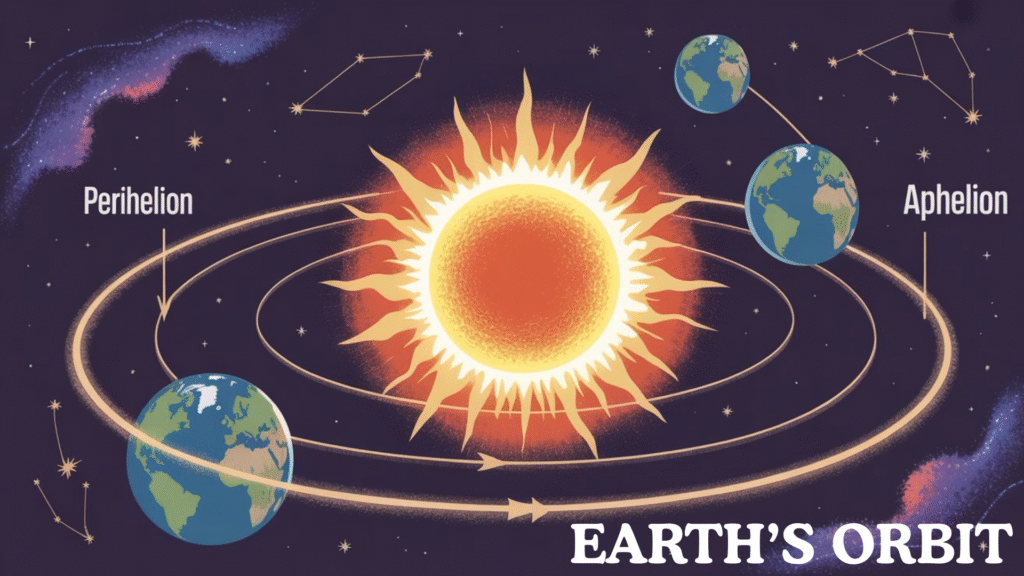
Earth’s Orbit
Earth’s orbit is the path our planet follows around the Sun. This path is not a perfect circle—it is an ellipse, slightly oval in shape. Earth takes 365.25 days to complete one revolution around the Sun, which determines our year. The orbit affects seasons, climate, temperature, daylight duration and the position of the Sun in the sky throughout the year. Understanding Earth’s orbit helps us learn how life on the planet is influenced by its movement, distance from the Sun and tilt of the axis. It also helps explain natural phenomena such as solstices, equinoxes, seasons and varying day and night lengths.
- What is Earth’s orbit?
ANSWER: It is the path Earth follows around the Sun. - What is the shape of Earth’s orbit?
ANSWER: It is an elliptical (oval-shaped) orbit. - Who proposed that planets move in elliptical orbits?
ANSWER: Johannes Kepler. - What keeps Earth in orbit around the Sun?
ANSWER: The Sun’s gravitational force. - How long does Earth take to orbit the Sun?
ANSWER: 365.25 days. - What does one revolution of Earth around the Sun represent?
ANSWER: One year. - What is perihelion?
ANSWER: The point in Earth’s orbit closest to the Sun. - When does perihelion occur?
ANSWER: Around January 3rd each year. - What is aphelion?
ANSWER: The point in Earth’s orbit farthest from the Sun. - When does aphelion occur?
ANSWER: Around July 4th each year. - Why does Earth experience seasons?
ANSWER: Because of its tilted axis and revolution around the Sun. - What is Earth’s axial tilt?
ANSWER: About 23.5 degrees. - Does the distance from the Sun cause seasons?
ANSWER: No, seasons occur due to the tilt of Earth’s axis. - Why is summer warmer?
ANSWER: Sunlight is more direct on the hemisphere tilted toward the Sun. - What happens during winter?
ANSWER: The hemisphere tilted away gets indirect sunlight and shorter days. - What occurs on the summer solstice?
ANSWER: The longest day of the year in that hemisphere. - What occurs on the winter solstice?
ANSWER: The shortest day of the year. - What are equinoxes?
ANSWER: Days when day and night are equal everywhere on Earth. - When does the vernal equinox occur?
ANSWER: Around March 21. - When does the autumnal equinox occur?
ANSWER: Around September 23. - What is orbital speed?
ANSWER: The speed at which Earth moves around the Sun. - What is Earth’s average orbital speed?
ANSWER: About 29.78 km/s. - Does Earth move faster at perihelion?
ANSWER: Yes, due to stronger gravity. - Does Earth move slower at aphelion?
ANSWER: Yes. - What law explains changing orbital speed?
ANSWER: Kepler’s Second Law (Law of Areas). - What is Kepler’s First Law?
ANSWER: Planets orbit the Sun in ellipses. - What is Kepler’s Third Law?
ANSWER: The square of the orbital period is proportional to the cube of the orbital radius. - What is eccentricity?
ANSWER: A measure of how stretched an orbit is. - Is Earth’s orbit highly eccentric?
ANSWER: No, it is almost circular (eccentricity ≈ 0.0167). - What is the orbital plane called?
ANSWER: The ecliptic plane. - What is rotation?
ANSWER: Earth spinning on its axis. - What does rotation cause?
ANSWER: Day and night. - What does revolution cause?
ANSWER: The year and seasonal changes. - How long is one rotation?
ANSWER: 24 hours. - Does Earth rotate and revolve simultaneously?
ANSWER: Yes. - Why do stars appear to move across the sky?
ANSWER: Due to Earth’s rotation. - Why does the Sun seem to move east to west?
ANSWER: Because Earth rotates west to east. - What is a leap year?
ANSWER: A year with an extra day added (February 29). - Why do we have leap years?
ANSWER: To adjust for the extra 0.25 day per year. - How often do leap years occur?
ANSWER: Every 4 years. - Does Earth’s orbit affect climate?
ANSWER: Yes, long-term climate is influenced by orbital changes. - What are Milankovitch cycles?
ANSWER: Long-term changes in Earth’s orbit that affect climate. - Can orbital variation cause ice ages?
ANSWER: Yes. - What three factors make Milankovitch cycles?
ANSWER: Eccentricity, axial tilt, and precession. - What is precession?
ANSWER: Slow wobbling of Earth’s axis. - How long is a full precession cycle?
ANSWER: About 26,000 years. - What is axial tilt variation?
ANSWER: Slow change in the angle of Earth’s tilt. - Can tilt changes affect seasons?
ANSWER: Yes, more tilt makes seasons more extreme. - What is orbital inclination?
ANSWER: The tilt of Earth’s orbital plane relative to the solar plane. - Does Earth’s orbit change over millions of years?
ANSWER: Yes, due to gravitational influences. - What is insolation?
ANSWER: Incoming solar radiation. - Does insolation vary by season?
ANSWER: Yes. - Why is insolation higher in summer?
ANSWER: Direct sunlight and longer days. - What hemisphere gets more insolation in January?
ANSWER: The Southern Hemisphere. - Why does the Southern Hemisphere have milder summers?
ANSWER: Oceans absorb heat more effectively. - What is solar declination?
ANSWER: The Sun’s angle relative to the equator. - What latitude receives direct sun on equinoxes?
ANSWER: The Equator. - What latitude receives direct sun on the summer solstice?
ANSWER: Tropic of Cancer. - What latitude receives direct sun on the winter solstice?
ANSWER: Tropic of Capricorn. - What is the Arctic Circle?
ANSWER: Latitude where at least one day has 24 hours of daylight or darkness. - What is an eclipse?
ANSWER: Blocking of one celestial body by another. - What causes a solar eclipse?
ANSWER: Moon blocking the Sun. - What causes a lunar eclipse?
ANSWER: Earth blocking sunlight from the Moon. - Why don’t we have eclipses every month?
ANSWER: Because the Moon’s orbit is tilted. - What is the ecliptic?
ANSWER: The apparent path of the Sun across the sky. - What is a solstice?
ANSWER: Day when Sun reaches its highest or lowest point in the sky. - What is the longest day of the year in India?
ANSWER: June 21. - What is the shortest day of the year in India?
ANSWER: December 22. - When is the Sun directly overhead at the Equator?
ANSWER: On equinox days. - What marks the beginning of astronomical winter?
ANSWER: Winter solstice. - What is orbital velocity?
ANSWER: Speed needed to stay in orbit. - What is gravitational force?
ANSWER: Attraction between two masses. - What stops Earth from flying off into space?
ANSWER: Sun’s gravity. - What prevents Earth from falling into the Sun?
ANSWER: Earth’s forward motion. - What is centrifugal force in orbit?
ANSWER: Outward force due to motion. - Does Earth’s orbital speed change?
ANSWER: Yes—faster near the Sun, slower far away. - What is the barycenter?
ANSWER: The center of mass of a system (Sun–Earth). - Does Earth tilt change over time?
ANSWER: Yes, slowly. - Can other planets affect Earth’s orbit?
ANSWER: Yes, especially Jupiter and Saturn. - Will Earth’s orbit remain stable?
ANSWER: Yes, for millions of years. - Why do we have calendars?
ANSWER: To track Earth’s orbit and seasons. - Why are months uneven in length?
ANSWER: Historical and astronomical reasons. - What is a solar year?
ANSWER: Time Earth takes to orbit the Sun. - How many seasons exist because of the orbit?
ANSWER: Four major seasons. - Why is February shorter?
ANSWER: Adjustment for the 365.25-day year. - Why does daylight change throughout the year?
ANSWER: Due to Earth’s tilt and orbit. - Can orbit affect agriculture?
ANSWER: Yes, through seasons and climate. - Does GPS depend on Earth’s orbit?
ANSWER: Yes, satellite orbits are related to Earth's motion. - Does the orbit influence tides?
ANSWER: The Moon affects tides more than the Sun. - Can orbital changes affect wildlife behavior?
ANSWER: Yes, migration and breeding patterns follow seasons. - What causes the Sun’s apparent movement?
ANSWER: Earth’s rotation and orbit. - Why is the noon Sun highest in summer?
ANSWER: The hemisphere is tilted toward the Sun. - Why are polar regions extremely cold?
ANSWER: They receive very little direct sunlight. - What is the solar constant?
ANSWER: Average solar energy received per unit area. - Does the solar constant vary?
ANSWER: Slightly, due to Earth’s elliptical orbit. - What is Earth’s orbital radius?
ANSWER: About 150 million km. - What unit is based on Earth’s orbit?
ANSWER: Astronomical Unit (AU). - What is the value of 1 AU?
ANSWER: Approximately 150 million km. - Why is Earth habitable?
ANSWER: It orbits the Sun within the habitable zone. - What is the habitable zone?
ANSWER: Region where conditions allow liquid water.
Earth’s orbit is a fundamental aspect of our existence. It governs the length of the year, the cycle of seasons and the distribution of sunlight across the planet. Combined with Earth’s axial tilt, the orbit determines the climate patterns that support diverse ecosystems and human life. Understanding Earth’s orbit deepens our knowledge of astronomy, weather, geography, and environmental science. It also helps us appreciate how perfectly balanced our planet’s motion is within the solar system. Learning about Earth’s orbit not only builds scientific awareness but also provides insight into the delicate mechanisms that make life on Earth possible.
FAQs
- Why isn’t Earth’s orbit a perfect circle?
Earth’s orbit is influenced by the gravity of the Sun and other planets, making it slightly elliptical.
- Will Earth’s orbit ever become circular?
No, but the eccentricity changes slightly over time.
- Is Earth moving closer to the Sun?
No, the average distance remains nearly constant.
- Can Earth fall out of orbit?
No, orbit is stable due to gravitational balance.
- Why does Earth move faster near the Sun?
Because gravity is stronger at perihelion.
- Does Earth always have the same axial tilt?
No, it changes slightly over thousands of years.
- How does Earth’s orbit affect seasons?
The orbit and tilt together determine sunlight intensity and duration.
- Why do different hemispheres have opposite seasons?
Because they tilt in opposite directions relative to the Sun.
- What would happen if Earth’s tilt were zero?
There would be no seasons.
- How important is Earth’s orbit for life?
Extremely important—it controls climate, temperature and habitability.
Related Articles:
- The Mauryan Empire
- Ancient History of India
- Indus Valley Civilization
- Vedic Civilization
- The Solar System
- The Earth


