
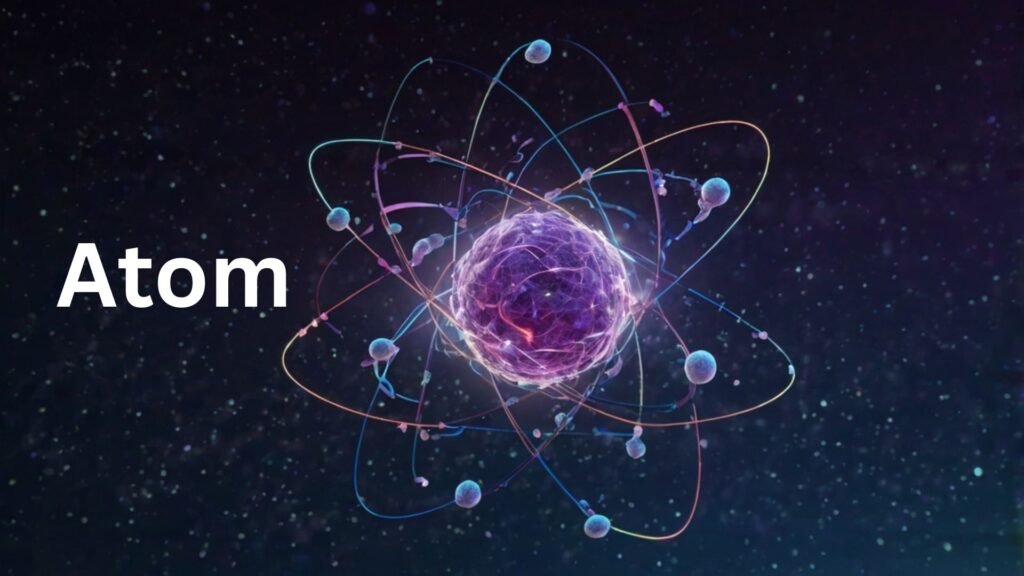
Atom
An atom is the smallest unit of matter that retains the chemical properties of an element. Every substance around us—solid, liquid, gas or plasma—is made up of atoms. An atom consists mainly of three fundamental particles: electrons, protons and neutrons. These particles are arranged in a small, dense nucleus surrounded by an electron cloud. Understanding atoms is essential in physics, chemistry, and competitive examinations because it forms the foundation of all scientific knowledge. Concepts like atomic structure, electron configuration, isotopes, atomic models and modern theories help students understand how elements behave and form compounds.
- Who first proposed the concept of the atom?
Answer: Maharshi Kanad (ancient India) and later by John Dalton scientifically.
- Who is known as the father of modern atomic theory?
Answer: John Dalton.
- Which particle carries a positive charge?
Answer: Proton.
- Which particle carries a negative charge?
Answer: Electron.
- Which particle in an atom is neutral?
Answer: Neutron.
- Who discovered the electron?
Answer: J.J. Thomson.
- Who discovered the proton?
Answer: Ernest Rutherford.
- Who discovered the neutron?
Answer: James Chadwick.
- What is the charge of a proton?
Answer: +1.
- What is the charge of an electron?
Answer: –1.
- What is the mass of an electron?
Answer: 9.1 × 10⁻³¹ kg (very small/negligible).
- What is the mass of a proton?
Answer: 1.67 × 10⁻²⁷ kg.
- What is the mass of a neutron?
Answer: 1.67 × 10⁻²⁷ kg (approximately equal to proton).
- What is the nucleus?
Answer: The central part of an atom containing protons and neutrons.
- Who proposed the plum pudding model?
Answer: J.J. Thomson.
- Who proposed the nuclear model?
Answer: Rutherford.
- Who proposed the planetary model of the atom?
Answer: Niels Bohr.
- What is an atomic number?
Answer: Number of protons in an atom.
- What is mass number?
Answer: Number of protons + number of neutrons.
- What are isotopes?
Answer: Atoms of the same element with different number of neutrons.
- What are isobars?
Answer: Atoms with the same mass number but different atomic numbers.
- What are isotones?
Answer: Atoms with the same number of neutrons.
- What is an ion?
Answer: An atom having gained or lost electrons.
- Cation means?
Answer: Positively charged ion.
- Anion means?
Answer: Negatively charged ion.
- What is electron configuration?
Answer: Arrangement of electrons in an atom.
- What is the charge of a neutron?
Answer: Zero.
- What is the smallest particle of an element?
Answer: Atom.
- What are subatomic particles?
Answer: Electron, proton, neutron.
- What is the Bohr orbit?
Answer: Fixed circular path of electrons.
- What is the K-shell?
Answer: First electron shell.
- What is the maximum number of electrons in K-shell?
Answer: 2.
- Maximum electrons in L-shell?
Answer: 8.
- Maximum electrons in M-shell?
Answer: 18.
- Rule for electrons per shell?
Answer: 2n².
- Who discovered that electrons travel in specific orbits?
Answer: Niels Bohr.
- What is an orbital?
Answer: Region where electrons are most likely to be found.
- What is the shape of an s-orbital?
Answer: Spherical.
- Shape of a p-orbital?
Answer: Dumbbell-shaped.
- What determines chemical properties of elements?
Answer: Number of electrons in the outermost shell.
- What is valency?
Answer: Combining capacity of an atom.
- What is the atomic mass unit (amu)?
Answer: 1/12 mass of carbon-12.
- What is meant by atomic radius?
Answer: Size of an atom.
- What is Avogadro’s number?
Answer: 6.022 × 10²³.
- What is a neutral atom?
Answer: Protons = electrons.
- What is a stable octet?
Answer: 8 electrons in the valence shell.
- What is the charge of the nucleus?
Answer: Positive.
- What is radioactivity?
Answer: Spontaneous decay of unstable nuclei.
- Who discovered radioactivity?
Answer: Henri Becquerel.
- Who discovered the nucleus?
Answer: Rutherford.
- What is the speed of electrons in orbit?
Answer: Nearly speed of light.
- Who gave the uncertainty principle?
Answer: Werner Heisenberg.
- What is the uncertainty principle?
Answer: Exact position and momentum of electrons cannot be known simultaneously.
- What is a quantum number?
Answer: Number describing the state of an electron.
- What is principal quantum number?
Answer: Describes main energy level (n).
- Azimuthal quantum number?
Answer: Describes orbital shape (l).
- Magnetic quantum number?
Answer: Orientation of the orbital (m).
- Spin quantum number?
Answer: Spin of electron (+½ or –½).
- What is Pauli’s exclusion principle?
Answer: No two electrons can have same set of four quantum numbers.
- What is Hund’s rule?
Answer: Every orbital must be singly filled before double filling.
- Which particle determines the identity of an element?
Answer: Proton.
- Which particle determines the isotope of an element?
Answer: Neutron.
- What is electron affinity?
Answer: Energy released when an electron is added to an atom.
- What is ionization energy?
Answer: Energy required to remove an electron.
- Which element has the smallest atom?
Answer: Helium (size-wise), Hydrogen (mass-wise).
- What is the mass of hydrogen atom?
Answer: 1 amu.
- What is the lightest particle?
Answer: Electron.
- What is the heaviest particle in atom?
Answer: Neutron (slightly heavier than proton).
- What is atomic mass?
Answer: Weighted average of all isotopes.
- What are alpha particles?
Answer: Helium nuclei (2 protons + 2 neutrons).
- Beta particles are?
Answer: High-speed electrons.
- Gamma rays are?
Answer: Electromagnetic waves.
- Which particle is used in Rutherford’s experiment?
Answer: Alpha particles.
- What was gold foil used for?
Answer: Rutherford's scattering experiment.
- What did Rutherford’s experiment prove?
Answer: Existence of nucleus.
- What is the charge of alpha particle?
Answer: +2.
- What is mass number of alpha particle?
Answer: 4.
- What is relative mass of electron?
Answer: 1/1836 of a proton.
- What is cathode ray?
Answer: Stream of electrons.
- What are anode rays?
Answer: Positive rays (canal rays).
- Who discovered canal rays?
Answer: Goldstein.
- What is the size of an atom?
Answer: 10⁻¹⁰ meters.
- What is the size of nucleus?
Answer: 10⁻¹⁵ meters.
- What is nuclear density?
Answer: Extremely high.
- What is binding energy?
Answer: Energy holding nucleus together.
- What are nucleons?
Answer: Protons + neutrons.
- What are leptons?
Answer: Particles like electrons and neutrinos.
- What is the atomic symbol?
Answer: Notation showing atomic number and mass number.
- What is a molecule?
Answer: Two or more atoms bonded together.
- What is a compound?
Answer: Molecules of different elements combined.
- What is the nucleus made of?
Answer: Protons and neutrons.
- Which particle revolves around the nucleus?
Answer: Electron.
- What holds electrons in orbit?
Answer: Electrostatic force.
- What is effective nuclear charge?
Answer: Net positive charge experienced by electrons.
- What is periodicity?
Answer: Repeating trends in periodic table.
- Who gave the wave model of electron?
Answer: Schrödinger.
- What is a wave function?
Answer: Describes electron probability.
- What is electron cloud?
Answer: Region where electrons are found.
- What is shielding effect?
Answer: Inner electrons blocking nuclear pull.
- What is atomic spectrum?
Answer: Colours emitted/absorbed by atoms.
The study of atoms is fundamental to understanding the structure, behaviour and properties of matter. From ancient atomic concepts to modern quantum theories, the evolution of atomic models has transformed science. Atoms play a crucial role in chemical bonding, physical properties, nuclear reactions, and everyday materials. For competitive exams, mastering the basics of atomic structure—including subatomic particles, electron configuration, isotopes, and quantum numbers—is essential. With proper understanding, students can easily answer objective, analytical and conceptual questions on this topic.
FAQs
- What is the importance of studying atoms?
Atoms form the basis of chemistry, physics and material science, helping us understand matter and its behaviour.
- Why are electrons not found inside the nucleus?
Because they are bound by electrostatic force and move around the nucleus in orbitals.
- How many atoms are in 1 mole?
6.022 × 10²³ atoms (Avogadro’s number).
- Why is an atom neutral?
Because the number of protons equals the number of electrons.
- Can atoms be divided?
Yes, but only in nuclear reactions—not in ordinary chemical reactions.
- What is the key difference between proton and electron?
Proton is positively charged and heavy; electron is negatively charged and extremely light.
- Which is heavier: proton or neutron?
Neutron is slightly heavier.
- Why are isotopes important?
They are used in medicine, dating fossils, and nuclear energy.
- What makes an atom stable?
A full outer electron shell (octet rule).
- Which model of atom is accepted today?
Quantum mechanical model.
Related Articles:


