
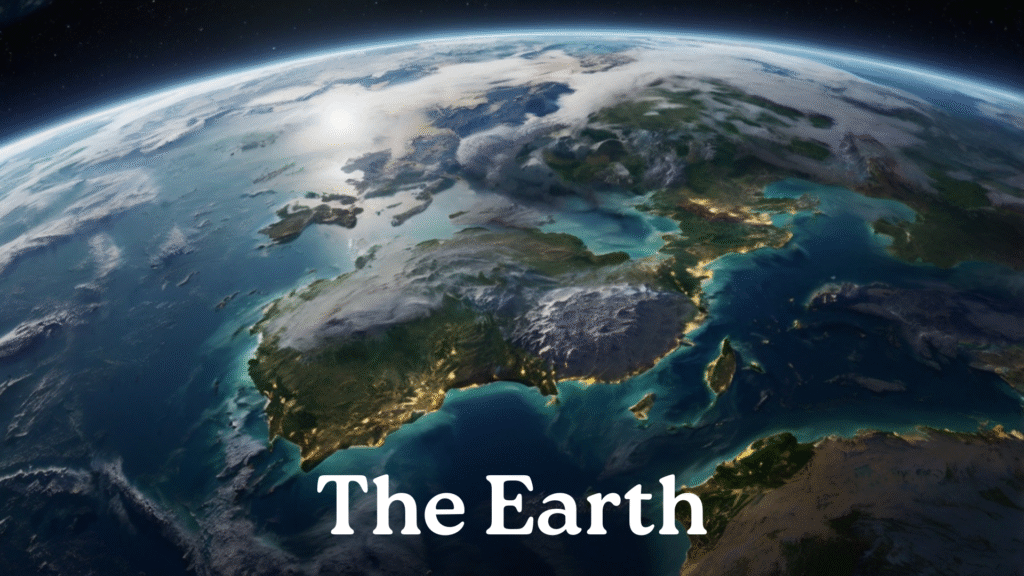
The Earth
Earth is the third planet from the Sun and the only known planet that supports life. It has a unique combination of air, water, land, and temperature that makes life possible. About 71% of Earth is covered with water, while the rest is landmasses formed by continents and islands. Earth has a protective atmosphere that shields us from harmful rays, maintains temperature and provides oxygen for living beings.
The planet also rotates on its axis, causing day and night, and revolves around the Sun, causing seasons. With mountains, oceans, forests, plains, deserts and polar ice caps, Earth is rich in natural features and biodiversity. Understanding Earth helps us appreciate nature and encourages us to protect it for future generations.
- What is the shape of the Earth?
Earth is an oblate spheroid.
- Why is Earth called a unique planet?
Because it supports life.
- What percentage of Earth is covered by water?
About 71%.
- What percentage of Earth is land?
About 29%.
- What is the diameter of the Earth?
Approximately 12,742 km.
- What is Earth’s position from the Sun?
Third planet.
- What is the Earth’s atmosphere?
A layer of gases surrounding the Earth.
- Which gas is most abundant in Earth’s atmosphere?
Nitrogen (78%).
- Which gas is essential for human breathing?
Oxygen.
- What protects Earth from harmful UV rays?
- What causes day and night?
- How long does Earth take to rotate once?
24 hours.
- What causes seasons?
Earth’s revolution and tilt.
- How long is Earth’s revolution around the Sun?
365 days and 6 hours.
- What is Earth’s axis?
An imaginary line passing through the North and South Poles.
- What is the tilt of Earth’s axis?
23.5 degrees.
- Which is the closest layer of the atmosphere to the Earth?
- Which layer contains the ozone layer?
Stratosphere.
- Which is the coldest layer of the atmosphere?
Mesosphere.
- Which is the hottest layer of the atmosphere?
- Which gas is responsible for the greenhouse effect?
Carbon dioxide.
- What is the largest continent?
Asia.
- What is the smallest continent?
- What is the largest ocean?
- What is the smallest ocean?
Arctic Ocean.
- Which is the longest river in the world?
- Which is the largest desert in the world?
- What is Earth’s natural satellite?
The Moon.
- How long does the Moon take to revolve around the Earth?
27.3 days.
- What causes tides?
The gravitational pull of the Moon and Sun.
- What is Earth’s crust?
The outermost solid layer.
- What is the mantle?
A thick layer of semi-solid rock beneath the crust.
- What is the core?
Earth’s innermost part.
- What is the inner core made of?
Solid iron and nickel.
- What is the outer core made of?
Liquid iron and nickel.
- What type of planet is Earth?
Terrestrial (rocky) planet.
- What is Earth’s gravity?
A force that pulls objects toward its center.
- What is the average temperature of Earth?
Around 15°C.
- Which is the deepest ocean trench?
Mariana Trench.
- What are continents?
Large landmasses on Earth.
- How many continents are there?
Seven.
- Name the seven continents.
Asia, Africa, North America, South America, Antarctica, Europe, Australia.
- What is a hemisphere?
Half of the Earth.
- What divides the Earth into Northern and Southern Hemispheres?
Equator.
- What divides the Earth into Eastern and Western Hemispheres?
Prime Meridian.
- What is the Equator?
An imaginary line around the Earth’s middle.
- What is latitude?
Distance north or south of the Equator.
- What is longitude?
Distance east or west of the Prime Meridian.
- What is the Earth’s largest mountain range?
- Which is the highest peak on Earth?
- What are tectonic plates?
Large pieces of Earth’s crust that move.
- What causes earthquakes?
Movement of tectonic plates.
- What causes volcanoes?
Magma rising from the mantle.
- What is erosion?
Wearing away of land by wind, water, or ice.
- What is weathering?
Breaking down of rocks.
- What is climate?
Long-term weather patterns.
- What is weather?
Daily atmospheric condition.
- What is the water cycle?
Circulation of water on Earth.
- What is evaporation?
Water turning into vapor.
- What is condensation?
Vapor turning into cloud droplets.
- What is precipitation?
Rain, snow, hail, or sleet.
- What is the biosphere?
Regions where life exists.
- What is the hydrosphere?
All water bodies on Earth.
- What is the lithosphere?
Earth’s rocky surface.
- What is the atmosphere?
Layers of gases around Earth.
- Which planet is called Earth’s twin?
Venus (similar size).
- What is the speed of Earth’s rotation?
About 1670 km/hr at the equator.
- What is the speed of Earth’s revolution?
About 30 km/s.
- What is a solar eclipse?
Moon blocks sunlight.
- What is a lunar eclipse?
Earth blocks sunlight to the Moon.
- What is Earth’s average distance from the Sun?
150 million km.
- What is the greenhouse effect?
Warming of Earth by greenhouse gases.
- What is global warming?
Rise in Earth’s temperature.
- What is a glacier?
A large mass of ice.
- What is a valley?
Low land between hills.
- What is a plateau?
A flat elevated landform.
- What is a plain?
A flat level land area.
- What is a delta?
Land formed at the mouth of a river.
- What is a peninsula?
Land surrounded by water on three sides.
- What is an island?
Land surrounded by water.
- What is an archipelago?
A group of islands.
- What is soil?
A mixture that supports plant life.
- What forms soil?
Weathering of rocks.
- What is humus?
Decayed plant and animal matter.
- What is a natural resource?
Things from nature useful to humans.
- What is a renewable resource?
Resources that can be replaced.
- What is a non-renewable resource?
Resources that cannot be replaced quickly.
- What is freshwater?
Water without salt.
- What is the largest freshwater lake?
Lake Baikal.
- What is an ecosystem?
Living and nonliving things interacting.
- What is biodiversity?
Variety of life on Earth.
- What is deforestation?
Cutting down trees.
- What is pollution?
Contamination of the environment.
- What protects Earth from meteors?
Atmosphere burns them.
- What is Earth’s magnetic field?
An invisible force protecting Earth from solar wind.
- What causes auroras?
Solar wind interacting with Earth’s magnetic field.
- What is the coldest place on Earth?
- What is the hottest place on Earth?
Death Valley, USA.
- Which continent has no permanent population?
- Why is Earth important to study?
It helps us understand life, nature and environmental protection.
The Earth is a remarkable planet with unique features that support life. From its atmosphere and water bodies to its mountains, plains, and rich biodiversity, Earth offers everything needed for survival. Understanding the Earth helps us use natural resources wisely and protect the environment. As climate change and pollution increase, it becomes more important for every individual to respect and care for the planet. Learning about Earth inspires responsibility and helps us build a safer and healthier future for all living beings.
FAQs
- Why is Earth called the Blue Planet?
Because most of its surface is covered by water.
- Why is Earth suitable for life?
Because it has water, oxygen, and a suitable temperature.
- How old is the Earth?
About 4.5 billion years old.
- How many layers does the Earth have?
Three main layers: crust, mantle, and core.
- What is the main source of energy for Earth?
The Sun.
- What protects Earth from harmful radiation?
The ozone layer.
- Why is it important to protect Earth?
Because it is our only home, and life depends on a healthy environment.
- What is the biggest environmental threat today?
Climate change and global warming.
- How can we protect Earth?
By saving water, planting trees, reducing pollution and using renewable energy.
- Which is the largest living ecosystem on Earth?
The ocean ecosystem.
Related Articles:


