
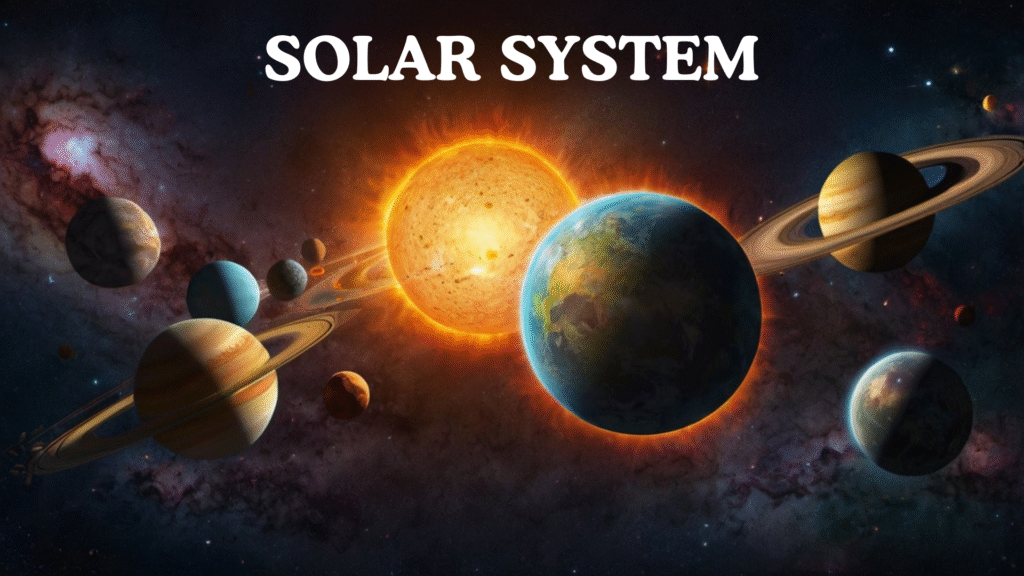
The Solar System
The Solar System is a vast and fascinating part of our universe, consisting of the Sun, eight planets, their moons, dwarf planets, asteroids, comets, and countless other celestial bodies. Formed around 4.6 billion years ago, it is held together by the Sun’s gravity, which serves as the central source of heat and light. Each planet is unique in its size, temperature, composition, and distance from the Sun. Learning about the Solar System helps us understand how planets formed, how life evolved on Earth and how space continues to influence our world today. It is a key topic in science that encourages curiosity and exploration.
- What is the Solar System?
A system of the Sun and all objects orbiting it. - How old is the Solar System?
Approximately 4.6 billion years old. - What is at the center of the Solar System?
The Sun. - What holds the Solar System together?
The Sun’s gravitational force. - How many planets are in the Solar System?
Eight. - Name the eight planets.
Mercury, Venus, Earth, Mars, Jupiter, Saturn, Uranus, Neptune. - Which planet is closest to the Sun?
Mercury. - Which planet is farthest from the Sun?
Neptune. - What are the inner planets made of?
Rock. - What are the inner planets?
Mercury, Venus, Earth, Mars. - What are the outer planets made of?
Gas and ice. - What are the outer planets?
Jupiter, Saturn, Uranus, Neptune. - What are dwarf planets?
Small planetary bodies that orbit the Sun but do not clear their orbit. - Name a well-known dwarf planet.
Pluto. - What is an orbit?
The path an object takes around the Sun. - What is rotation?
The spinning of a planet on its axis. - What is revolution?
The movement of a planet around the Sun. - Which planet has the shortest day?
Jupiter. - Which planet has the longest day?
Venus. - Why is Earth called the “Blue Planet”?
Because of its abundant water. - What is the Sun?
A star. - What is the Sun mostly made of?
Hydrogen and helium. - What process gives the Sun its energy?
Nuclear fusion. - What percentage of the Solar System’s mass does the Sun contain?
About 99.8%. - What is the surface temperature of the Sun?
Around 5,500°C. - Which planet is the smallest?
Mercury. - Does Mercury have an atmosphere?
Very thin, almost none. - Why does Mercury have extreme temperatures?
Due to lack of atmosphere. - Which planet is the hottest?
Venus. - Why is Venus so hot?
Because of its thick carbon dioxide atmosphere. - What is Venus often called?
Earth’s “twin planet.” - Which planet rotates backward?
Venus. - What makes Earth unique?
It supports life. - What gas is essential for human life?
Oxygen. - What protects Earth from harmful rays?
The ozone layer. - What percentage of Earth is covered by water?
About 71%. - What is Earth’s only natural satellite?
The Moon. - How long does the Moon take to orbit Earth?
27.3 days. - What causes moon phases?
The Moon’s position relative to Earth and the Sun. - What is Mars called?
The Red Planet. - Why is Mars red?
Due to iron oxide on its surface. - Does Mars have water?
Yes, as ice. - What is the tallest volcano on Mars?
Olympus Mons. - Which is the largest planet?
Jupiter. - What is Jupiter known for?
The Great Red Spot. - What is the Great Red Spot?
A giant storm. - Does Jupiter have rings?
Yes, faint rings. - Which planet has the most beautiful rings?
Saturn. - What are Saturn’s rings made of?
Ice, rock, and dust. - Is Saturn a gas giant?
Yes. - Which planet rotates on its side?
Uranus. - What color is Uranus?
Pale blue. - Why does Uranus appear blue?
Methane gas. - Which planet has the strongest winds?
Neptune. - What color is Neptune?
Deep blue. - Which gas gives Neptune its color?
Methane. - What is the Kuiper Belt?
A region of icy bodies beyond Neptune. - Where is Pluto located?
In the Kuiper Belt. - What is the Asteroid Belt?
A region between Mars and Jupiter filled with asteroids. - What are comets made of?
Ice, dust and rock. - What causes a comet’s tail?
Solar radiation. - What are meteors commonly known as?
Shooting stars. - What is a meteorite?
A meteor that reaches Earth’s surface. - What is a meteoroid?
A small rock in space. - What is a light-year?
The distance light travels in one year. - What is AU (Astronomical Unit)?
The distance from Earth to the Sun. - How many AU is Earth from the Sun?
1 AU. - How many moons does Jupiter have?
79 known moons. - Which moon is the largest in the Solar System?
Ganymede. - Which moon has liquid methane lakes?
Titan (Saturn’s moon). - Which moon may support life?
Europa (Jupiter’s moon). - What is the heliosphere?
The Sun’s magnetic bubble. - What is a solar eclipse?
Moon blocks the Sun. - What is a lunar eclipse?
Earth blocks sunlight from the Moon. - What causes tides on Earth?
The Moon’s gravity. - What is Earth’s atmosphere mainly made of?
Nitrogen and oxygen. - Which planet has no moons?
Mercury and Venus. - Which planet has the most moons?
Jupiter. - Which planet has a day longer than its year?
Venus. - Which planet has rings besides Saturn?
All gas giants. - Which planet is known as the Morning Star/Evening Star?
Venus. - Which planet is tilted 98 degrees?
Uranus. - Which planet has blue-green color?
Uranus. - What protects Earth from solar winds?
The magnetosphere. - Which planet is famous for giant storms?
Jupiter. - Which planet takes the longest to orbit the Sun?
Neptune (165 years). - Which planet is known as the Water Planet?
Earth. - Which planet is known for dust storms?
Mars. - Which planet has a thin carbon dioxide atmosphere?
Mars. - Which planet was discovered first with a telescope?
Uranus. - Which planet was discovered mathematically?
Neptune. - Which planet has seasonal changes?
Mars. - Which planet is most similar to Earth in size?
Venus. - What is a galaxy?
A large collection of stars and planets. - Which galaxy is the Solar System in?
The Milky Way. - What is the Milky Way?
Our home galaxy. - What is a black hole?
A region with strong gravity where even light cannot escape. - Is the Sun a medium-sized star?
Yes. - Will the Sun live forever?
No, it will become a red giant after 5 billion years. - Why is studying the Solar System important?
To understand space, Earth’s history, and the potential for life elsewhere.
The Solar System is a remarkable and complex part of our universe, offering endless opportunities for exploration and learning. Its planets, moons and other celestial bodies reveal how space works and how Earth fits into the larger cosmos. By understanding the Solar System, we gain insights into the origins of life, the movement of planets and the potential for human exploration beyond Earth. This knowledge helps build scientific curiosity and inspires future discoveries about our vast and amazing universe.
FAQs
- Why is the Sun important?
Because it provides heat, light, and energy for all life on Earth.
- Which planet is known as the Red Planet?
Mars.
- Why is Earth suitable for life?
It has water, oxygen, a suitable climate and a protective atmosphere.
- What is a dwarf planet?
A small planetary body that orbits the Sun but does not clear its orbit.
- Why does Pluto not remain a planet?
Because it does not clear other objects in its orbit.
- Which is the hottest planet?
Venus.
- Which is the coldest planet?
Neptune.
- What causes seasons on Earth?
Earth’s tilted axis.
- Do all planets have moons?
No—Mercury and Venus have none.
- What is the Asteroid Belt?
A region of rocky objects between Mars and Jupiter.
Related Articles:


