
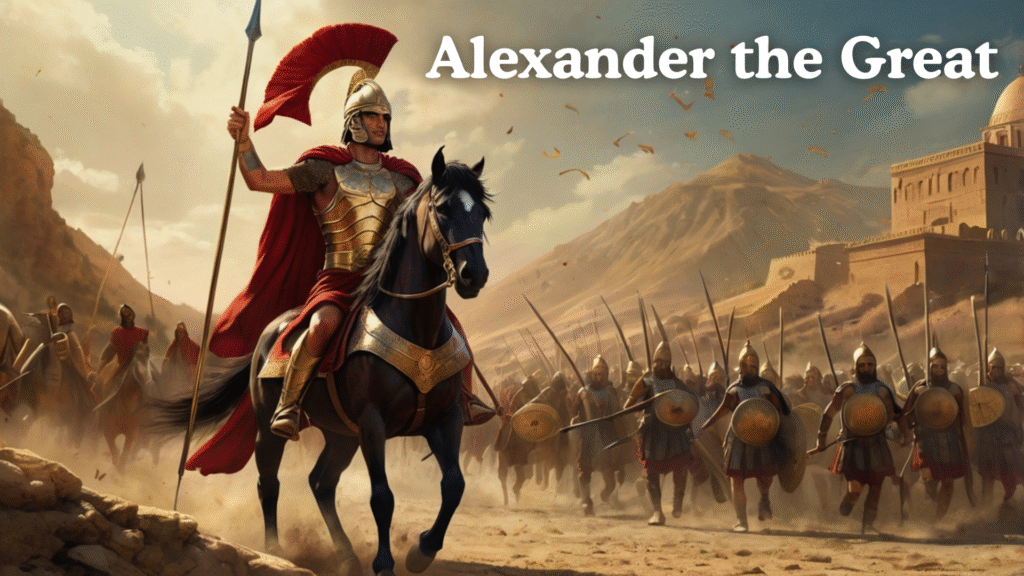
Alexander the Great
Alexander the Great, born in 356 BCE in Macedonia, is remembered as one of the greatest military leaders in world history. Trained by the famous philosopher Aristotle and inspired by his father King Philip II, Alexander expanded a small kingdom into one of the largest empires of the ancient world. His conquests stretched from Greece to Egypt, Persia and even parts of India. He spread Greek culture, founded many cities, and shaped the course of history through his leadership, strategy, and vision. The story of Alexander is not only about war, but also about ambition, intelligence, bravery and curiosity about the world.
- Who was Alexander the Great?
Alexander was the king of Macedonia and one of history’s greatest military conquerors.
- When was Alexander the Great born?
He was born in 356 BCE.
- Where was Alexander born?
In Pella, the capital of Macedonia.
- Who was Alexander’s father?
King Philip II of Macedonia.
- Who was Alexander’s mother?
Queen Olympias.
- Who was Alexander’s famous tutor?
Aristotle.
- At what age did Alexander become king?
At age 20.
- What was the name of Alexander’s horse?
Bucephalus.
- Which empire did Alexander mainly conquer?
The Persian Empire.
- Who was the Persian king defeated by Alexander?
Darius III.
- What was Alexander’s title in Egypt?
Pharaoh of Egypt.
- Which famous city did Alexander found in Egypt?
Alexandria.
- What was Alexander’s main goal?
To create a world empire.
- What was Alexander’s army called?
The Macedonian Army.
- What formation did Alexander’s army commonly use?
The phalanx formation.
- Which region did Alexander conquer first?
Greece.
- Which battle made Alexander famous at a young age?
The Battle of Chaeronea.
- In which battle did Alexander defeat Darius III for the first time?
The Battle of Issus.
- In which battle did Alexander give the final blow to Persia?
The Battle of Gaugamela.
- Which city did Alexander burn after capturing it?
Persepolis.
- What language did Alexander spread across his empire?
Greek.
- What is the name for the culture that blended Greek and Eastern traditions under Alexander?
Hellenistic culture.
- What river did Alexander cross to enter India?
The Indus River.
- Who was the Indian king who fought Alexander?
King Porus.
- Which battle did Alexander fight against Porus?
The Battle of Hydaspes.
- What impressed Alexander about King Porus?
His bravery.
- How did Alexander treat Porus after defeating him?
He made Porus a loyal ally and ruler.
- Why did Alexander’s soldiers refuse to march further in India?
They were tired and wanted to go home.
- What was the name of Alexander’s empire?
The Macedonian Empire.
- How long did Alexander rule?
For 12 years.
- What caused Alexander’s death?
Likely fever or illness (exact cause unknown).
- Where did Alexander die?
In Babylon.
- At what age did Alexander die?
At age 32.
- What was Alexander planning before his death?
Expanding further into Arabia.
- Did Alexander ever lose a battle?
No, he never lost a single battle.
- What was Alexander’s education based on?
Philosophy, science, literature, and warfare.
- Who succeeded Alexander after his death?
His generals, called the Diadochi, divided the empire.
- What happened to Alexander’s empire after his death?
It broke into several kingdoms.
- Which general took Egypt after Alexander’s death?
Ptolemy.
- Which general took Persia after Alexander’s death?
Seleucus.
- What does “Alexander the Great” imply?
His extraordinary achievements and military success.
- What was Alexander’s dream?
To unite all people under one empire.
- What did Alexander encourage among his soldiers?
Marriages with local women.
- Why did Alexander respect Greek culture?
He believed Greek culture symbolized learning and wisdom.
- What did Alexander’s founding of many cities help spread?
Greek language and culture.
- How many cities did Alexander name after himself?
About 20.
- What was Alexander’s relationship with Aristotle like?
He admired him and valued his teachings.
- What religion did Alexander follow?
Ancient Greek religion.
- What qualities made Alexander a good leader?
Bravery, strategy, intelligence, and charisma.
- Which mountain range did Alexander cross to reach India?
The Hindu Kush Mountains.
- Why was the Battle of Gaugamela important?
It ended Persian power.
- Which sea did Alexander cross during his campaigns?
The Mediterranean Sea.
- Why did Alexander destroy Thebes?
To stop a Greek rebellion.
- What was Alexander’s birthplace famous for?
Being a powerful Macedonian city.
- What did Alexander wear in battle?
A distinctive helmet and armor with Greek designs.
- What inspired Alexander’s military techniques?
His father Philip II’s army reforms.
- What role did Alexander’s mother play in his life?
She encouraged his belief in destiny and greatness.
- Why is Alexander admired even today?
His achievements changed world history.
- Did Alexander promote learning?
Yes, he valued education and knowledge.
- What was Alexander’s attitude toward conquered people?
He respected their culture.
- Why did Greek culture spread widely after Alexander’s rule?
He founded cities that became centers of Greek learning.
- What was Alexander’s famous quote?
“There is nothing impossible to him who will try.”
- What was the name of Alexander’s military companion unit?
The Companion Cavalry.
- What was the strongest unit in Alexander’s infantry?
The Macedonian Phalanx.
- Why was Bucephalus famous?
He was Alexander’s loyal war horse.
- How did Alexander treat his soldiers?
He shared hardships with them.
- What did Alexander do in Egypt?
He rebuilt and reorganized the region.
- Which oracle declared Alexander a “son of God”?
The Oracle of Siwa.
- What was Alexander’s military strategy known for?
Speed and surprise.
- What empire did Alexander end?
The Achaemenid Persian Empire.
- Did Alexander know about India before entering it?
Yes, through Greek historians and traders.
- What weapon was important in Alexander’s army?
The long spear called a “sarissa.”
- Why is Alexander called “the Great”?
Because of the vastness of his empire and achievements.
- Which philosopher influenced Alexander's thinking?
Aristotle.
- What did Alexander admire in Indian culture?
Philosophy and spiritual traditions.
- Which city in India did Alexander capture first?
Taxila.
- What happened after the Hydaspes battle?
Alexander built two cities.
- What did Alexander do to encourage unity?
He organized mass weddings.
- Which city was Alexander’s capital?
Pella, and later Babylon.
- How long did Alexander’s empire last?
Only during his lifetime.
- What does "Hellenistic" mean?
Greek culture mixed with Eastern cultures.
- Which historian wrote about Alexander?
Arrian.
- Did Alexander have siblings?
Yes, he had half-siblings.
- What did Alexander want to explore after India?
Arabia.
- Why is Alexander considered a visionary?
He planned for a cultural and political world union.
- What is the “Gordian Knot”?
A legendary knot Alexander cut to show boldness.
- Where did Alexander cut the Gordian Knot?
At Gordium.
- What was Alexander’s main weakness?
Excessive ambition.
- Which sea route did Alexander map?
The Persian Gulf region.
- Who was Alexander’s close friend?
Hephaestion.
- Did Alexander promote trade?
Yes, across his empire.
- Why did Alexander marry Roxana?
For alliance and affection.
- What did Alexander wear that showed leadership?
A lion-skin helmet.
- What did his empire’s breakup lead to?
New Hellenistic kingdoms.
- Who ruled Macedonia after Alexander?
Cassander.
- What was Alexander’s greatest legacy?
The spread of Greek culture.
- What did Alexander die without?
A clear successor.
- What was Alexander’s governing style?
Combination of Greek and local traditions.
- Why do historians admire Alexander?
For his unmatched military success.
- What symbolized the blending of cultures under Alexander?
His policy of fusion between Greeks and Asians.
Alexander the Great remains one of history’s most remarkable figures. His leadership, bravery, and strategic intelligence allowed him to create an empire that reshaped the ancient world. Even though he lived only 32 years, his achievements influenced language, culture, politics, and trade for centuries. Alexander’s legacy teaches us about ambition, unity, and the importance of cultural exchange. He is remembered not only as a conqueror, but also as a visionary who dreamed of bringing the world together.
FAQs
- Who was Alexander the Great?
He was the king of Macedonia and one of the most successful military leaders in history.
- Why is Alexander called “the Great”?
Because he created one of the largest empires and never lost a battle.
- Where did Alexander’s empire extend?
From Greece to Egypt, Persia, and parts of India.
- Who taught Alexander during his childhood?
The great philosopher Aristotle.
- When did Alexander die?
In 323 BCE in Babylon.
- What was Alexander’s greatest achievement?
Defeating the Persian Empire and spreading Greek culture.
- Did Alexander invade India?
Yes, he entered northwestern India and fought King Porus.
- Why did Alexander’s empire collapse after his death?
Because he left no strong successor.
- Did Alexander ever lose a battle?
No, he won every battle he fought.
- What is Alexander’s lasting legacy?
The Hellenistic culture and the spread of Greek ideas across Asia.
Related Articles:


