Vedic Civilization – Vedas, Aryans, Culture
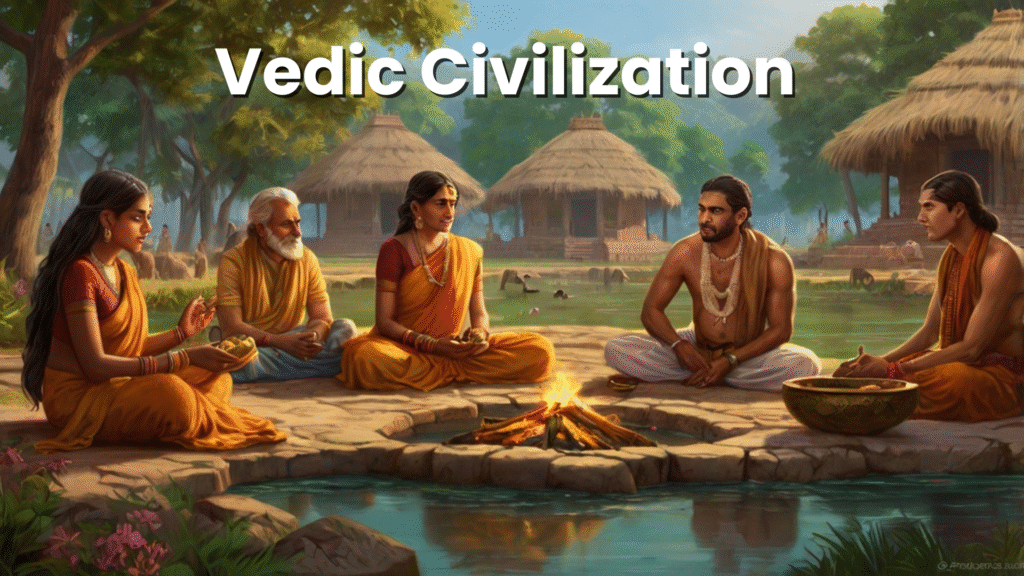
The Vedic Civilization is one of the most important periods in ancient Indian history, succeeding the Indus Valley Civilization. It began when the Aryans (a group of Indo-European-speaking people) migrated to the Indian subcontinent around 1500 BCE. They settled mainly in the northwestern regions of India, along the Saraswati and Ganga rivers.
The civilization derives its name from the Vedas, the oldest sacred texts of India, composed in Sanskrit. These texts — Rigveda, Samaveda, Yajurveda and Atharvaveda — form the foundation of Hindu philosophy, rituals and culture. The Vedic period is divided into Early (Rig Vedic) and Later Vedic phases, reflecting social, political and cultural evolution over time.
The Vedic Civilization contributed immensely to the development of Indian religion, language, governance, art and philosophy, laying the roots for later Indian society.
- Who were the Aryans?
Answer: Indo-European-speaking people who migrated to India around 1500 BCE.
- What does the word ‘Arya’ mean?
Answer: Noble or respectable.
- Where did the Aryans originally come from?
Answer: Central Asia (most historians agree).
- Which river was the center of the early Aryan settlements?
Answer: River Saraswati.
- What marks the beginning of the Vedic Civilization?
Answer: The composition of the Rigveda.
- What was the main occupation of the Aryans?
Answer: Agriculture and cattle rearing.
- Which animal was most important to the Aryans?
Answer: The cow.
- What did they call their settlements?
Answer: Grama (village).
- What language did the Aryans speak?
Answer: Sanskrit.
- What is the oldest literary source of Indian history?
Answer: The Rigveda.
- Which Veda is the oldest?
Answer: Rigveda.
- How many hymns are there in the Rigveda?
Answer: 1,028 hymns.
- Who were the Aryan priests called?
Answer: Purohitas.
- What was the main deity of the Rigvedic period?
Answer: Indra.
- What did the Aryans call their homeland?
Answer: Aryavarta.
- What was the main food of the Aryans?
Answer: Milk and milk products.
- What was the main social unit in Vedic society?
Answer: Family (Kula).
- What were assemblies in the Rigvedic period called?
Answer: Sabha and Samiti.
- What was the chief called in the Vedic period?
Answer: Rajan.
- What was the role of the king?
Answer: To protect his people and lead in war.
- What religion did the Aryans follow?
Answer: Nature worship.
- Who was the god of fire?
Answer: Agni.
- Who was the god of wind?
Answer: Vayu.
- Who was the goddess of dawn?
Answer: Ushas.
- Which god was associated with rain and thunder?
Answer: Indra.
- What was ‘Soma’?
Answer: A sacred drink used in rituals.
- What was the main form of worship?
Answer: Yajnas (sacrifices).
- Who performed sacrifices?
Answer: The priest (Brahmana).
- What did Aryans believe in after death?
Answer: Life after death or rebirth.
- Did they worship idols?
Answer: No, they worshipped forces of nature.
- Which was the most sacred river?
Answer: Saraswati.
- What was the term used for prayers in Rigveda?
Answer: Sukta.
- Who compiled the hymns?
Answer: Rishis (sages).
- What was the Vedic social order based on?
Answer: Occupation.
- Name the four varnas.
Answer: Brahmana, Kshatriya, Vaishya, and Shudra.
- What was the duty of a Brahmana?
Answer: To perform religious rituals and teach.
- What was the duty of a Kshatriya?
Answer: To protect and rule.
- What was the duty of a Vaishya?
Answer: To trade and farm.
- What was the duty of a Shudra?
Answer: To serve the other three classes.
- What was the Aryan economy mainly based on?
Answer: Agriculture and cattle rearing.
- When did the Later Vedic Age begin?
Answer: Around 1000 BCE.
- Which Vedas belong to the Later Vedic period?
Answer: Samaveda, Yajurveda, and Atharvaveda.
- What does the Yajurveda deal with?
Answer: Ritual formulas and sacrifices.
- What does the Samaveda deal with?
Answer: Musical chants.
- What does the Atharvaveda contain?
Answer: Magic spells and charms.
- What were Brahmanas?
Answer: Texts explaining rituals in the Vedas.
- What were Aranyakas?
Answer: Forest texts for meditation.
- What are Upanishads?
Answer: Philosophical texts about the soul and ultimate reality.
- What concept do Upanishads introduce?
Answer: Moksha and Atman-Brahman unity.
- What was the capital of the Kuru kingdom?
Answer: Hastinapur.
- What was the political system during the Later Vedic period?
Answer: Monarchy.
- What became the most important assembly later?
Answer: Sabha.
- What happened to the position of women in the Later Vedic period?
Answer: Their position declined.
- What was the role of kings during the Later Vedic age?
Answer: More powerful and hereditary rulers.
- What was the main source of income for the king?
Answer: Taxes (Bali).
- What was the new form of property in this age?
Answer: Land.
- What new rituals appeared?
Answer: Ashvamedha (horse sacrifice) and Rajasuya.
- What was the main metal used during this time?
Answer: Iron.
- What changes occurred in religion?
Answer: Idol worship and internal spirituality grew.
- What were Vedic schools called?
Answer: Gurukulas.
- What was the medium of instruction?
Answer: Sanskrit.
- Who were teachers called?
Answer: Gurus.
- What was the main aim of education?
Answer: Character formation and spiritual knowledge.
- What was the famous philosophical idea of Upanishads?
Answer: The unity of the soul (Atman) with the Supreme Being (Brahman).
- What is the Rigveda mainly about?
Answer: Hymns praising gods.
- What is the main subject of the Samaveda?
Answer: Music and chants.
- Which Veda gives information about magical charms?
Answer: Atharvaveda.
- What language are all Vedas written in?
Answer: Sanskrit.
- How many Upanishads are there traditionally?
Answer: 108.
- Which Upanishad is most famous?
Answer: Brihadaranyaka Upanishad.
- What was the term used for students?
Answer: Brahmachari.
- What was the ideal of a student’s life called?
Answer: Brahmacharya.
- What were the four stages of life according to Vedas?
Answer: Brahmacharya, Grihastha, Vanaprastha, and Sannyasa.
- What was the ultimate goal of life?
Answer: Moksha (liberation).
- What was the main form of marriage during the Vedic period?
Answer: Monogamy.
- What was the status of widows in early Vedic times?
Answer: They could remarry.
- Which science did Aryans know?
Answer: Astronomy and mathematics.
- What was the unit of time measurement?
Answer: Lunar months.
- What musical instrument is mentioned in Samaveda?
Answer: Veena.
- What was their main festival?
Answer: Yajna ceremonies.
- What was the social system called?
Answer: Varna system.
- Who formed the uppermost class?
Answer: Brahmanas.
- Who were responsible for war and defense?
Answer: Kshatriyas.
- Who handled trade and agriculture?
Answer: Vaishyas.
- Who served others?
Answer: Shudras.
- What kind of economy did they have?
Answer: Agrarian and pastoral.
- What crops did Aryans grow?
Answer: Barley, wheat, and rice (later period).
- What animal was used in ploughing?
Answer: Ox.
- What metal came into use in the Later Vedic period?
Answer: Iron.
- What was the main means of transport?
Answer: Chariots drawn by horses.
- What is the importance of Rigveda for history?
Answer: It gives the earliest record of Aryan life.
- What was the source of law?
Answer: The Vedas.
- What kind of government existed?
Answer: Monarchy with tribal assemblies.
- Who helped the king in administration?
Answer: Purohita, Senani, and Gramini.
- What was the main weapon of the Aryans?
Answer: Bow and arrow.
- What did Aryans use for trade?
Answer: Barter system.
- Did they use coins?
Answer: Not in the early period.
- What was the main source of wealth?
Answer: Cattle.
- Which civilization followed the Vedic Civilization?
Answer: The Mahajanapada period (around 600 BCE).
- What is the major contribution of the Vedic Civilization?
Answer: The foundation of Indian religion, philosophy and social systems.
The Vedic Civilization shaped the foundation of Indian society, religion, and culture. The Aryans introduced Sanskrit, the Vedas, and key social institutions that influenced every era that followed. From hymns and philosophy to governance and ethics, the Vedic period reflected spiritual depth and social organization. Its values of truth, duty (dharma), and moral living continue to guide Indian culture even today.
FAQs
- When did the Vedic Civilization begin?
Answer. Around 1500 BCE, after the decline of the Indus Valley Civilization. - Who were the Aryans?
Answer. Indo-European-speaking people who migrated to India from Central Asia. - What are the four Vedas?
Answer. Rigveda, Samaveda, Yajurveda, and Atharvaveda. - What was the main religion of the Aryans?
Answer. Nature worship involving gods like Indra, Agni, and Varuna. - What was the social system called?
Answer. Varna system — Brahmana, Kshatriya, Vaishya, and Shudra. - Which Veda is considered the oldest?
Answer. Rigveda. - What was the main occupation during the Vedic period?
Answer. Agriculture and cattle rearing. - What are Upanishads known for?
Answer. Philosophical ideas about the soul and ultimate reality (Atman and Brahman). - What was the language of the Vedas?
Answer. Sanskrit. - What is the legacy of the Vedic Civilization?
Answer. It laid the foundation for Indian religion, philosophy, and social order.


